Ai Certificate Generator
Create professional diplomas, awards, and certificates in seconds with AI
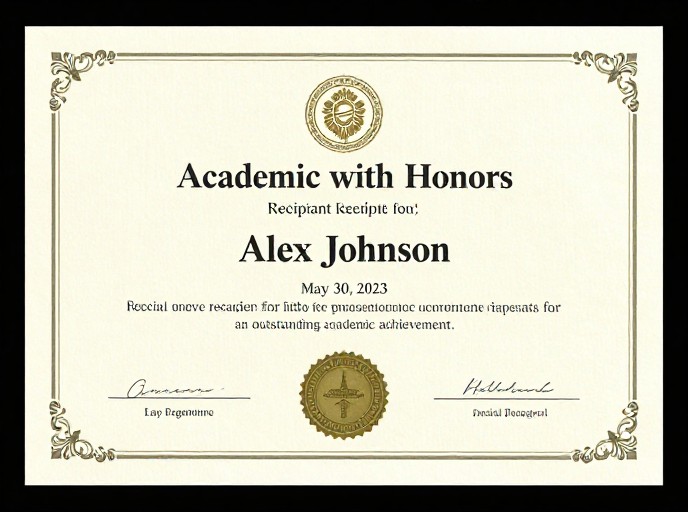
Ai Certificate Generator Examples
See what others have created
How to Get Started
Simple steps to create amazing results
Select Certificate Type
Choose from various certificate templates including awards, achievements, completion certificates, and more. Customize the layout to match your needs.
Enter Your Details
Add recipient names, dates, descriptions, and any custom text. Use AI to enhance wording and generate professional certificate content automatically.
Generate & Download
Let our AI create your high-quality certificate image instantly. Download in your preferred format and share or print immediately.
Main Features
Powerful capabilities at your fingertips
AI-Powered Design
Advanced AI generates professional certificate designs with elegant layouts, fonts, and styling automatically tailored to your specifications.
Customizable Templates
Choose from numerous certificate styles and fully customize colors, borders, emblems, and text to create certificates that match your brand or occasion.
Instant Download
Generate and download high-resolution certificate images in seconds. Perfect for printing or digital sharing with no watermarks.
Professional Quality
Create certificates that look authentically professional with sharp graphics, elegant typography, and polished finishing touches.
Unlimited Creation
Generate as many certificates as you need with no limits. Perfect for organizations, educators, and event planners.
Save Time
Skip expensive design software and lengthy creation processes. Generate beautiful certificates in minutes instead of hours.
Interesting Things You Might Not Know About Certificates
Ancient Paper Trail
The oldest known certificate dates back to 105 AD in China, when Ts'ai Lun invented paper and immediately used it to create official government documents that authenticated imperial decrees.
Papal Perfection
Medieval papal bulls (official certificates) were written on vellum and required an average of 3-4 animal skins per document, with some elaborate 15th-century examples using gold leaf worth today's equivalent of $50,000.
Watermark Warfare
The first security watermarks appeared on Italian certificates in 1282 in Bologna, created by varying the thickness of paper pulp to prevent forgery—a technique still used in 85% of official certificates today.
Diploma Mill History
The term 'diploma mill' originated in 1924 when the FBI discovered over 12,000 fake medical certificates issued by a single operation in Chicago, leading to the first federal laws regulating certificate authenticity.
Presidential Signatures
During his presidency, Chester A. Arthur personally signed over 40,000 military commission certificates between 1881-1885, averaging 27 signatures per day for four years straight.
Olympic Gold Standard
The 1896 Athens Olympics awarded only certificates to winners, not medals—the elaborate hand-calligraphed documents measured 60cm x 40cm and featured intricate borders requiring 15-20 hours of artistic work each.
Guinness World Record
The world's largest certificate measured 17.03 meters by 12.02 meters, created in India in 2018, requiring 47 liters of ink and a team of 12 calligraphers working continuously for 72 hours.
Vellum Victory
British Acts of Parliament are still printed on vellum (calfskin parchment) as they have been since 1497, with each copy requiring 2 calfskins and costing approximately £1,000 to produce in traditional format.
Calligraphy Economics
Professional certificate calligraphers in the 18th century earned 3-5 times the average worker's wage, with master scribes at Oxford and Cambridge charging the equivalent of $200 per certificate in today's currency.
Seal of Approval
Traditional wax seals on certificates required a temperature of exactly 65-75°C to apply properly; medieval seal-makers developed over 300 distinct wax recipes using ingredients from beeswax to dragon's blood resin.
Stock Certificate Art
19th-century stock certificates featured such elaborate engraving that a single certificate design required 400-600 hours of hand-engraving work, with collectors now paying up to $100,000 for rare railroad certificates from the 1860s.
UV Revolution
The introduction of UV-reactive inks in 1986 reduced certificate fraud by 78% within five years, combining invisible fibers, microprinting of text as small as 0.2mm, and holographic elements to create nearly impossible-to-forge documents.
Frequently Asked Questions
Everything you need to know
Ready to Get Started?
Create professional, AI-generated certificates in seconds. No design skills required.