Percentage Random Generator
Create custom virtual wheel spinners with adjustable segments and percentages for fair, random outcomes every time
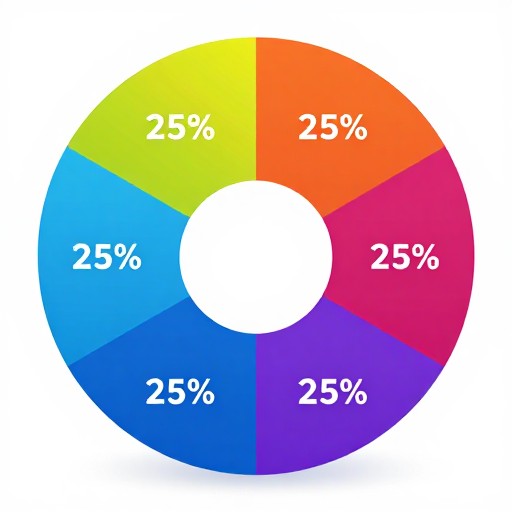
Percentage Random Generator Examples
See what others have created
How to Get Started
Simple steps to create amazing results
Set Your Percentages
Choose the number of segments and assign specific percentages to each option. Customize colors and labels to match your needs.
Generate Your Image
Click generate to create a visual representation of your percentage distribution as a professional wheel or chart image.
Download & Share
Save your generated percentage wheel image in high quality and use it for presentations, social media, or decision-making.
Main Features
Powerful capabilities at your fingertips
Customizable Design
Personalize your percentage wheel with custom colors, labels, and segment sizes to create the perfect visual representation.
Fair & Random Algorithm
Our advanced algorithm ensures true randomness and fairness when spinning the wheel, adhering to your specified percentages.
High-Quality Export
Download your percentage wheel as a crisp, high-resolution image ready for any use - from presentations to social media.
Instant Results
Generate professional percentage wheel images instantly with no waiting time or complicated setup required.
Interesting Things You Might Not Know About Percentage Random
The 50/50 Paradox
Despite being the most balanced probability, 50% randomness creates the least predictable patterns in visual art, as demonstrated in Marcel Duchamp's 1913 "3 Standard Stoppages" where he dropped meter-long threads from exactly 1 meter high.
Golden Random Ratio
Artists in the 1960s discovered that 61.8% randomness (the golden ratio as a percentage) creates the most aesthetically pleasing generative patterns, a principle still used in contemporary algorithmic art.
Cage's 4'33" Precision
John Cage's aleatory music compositions used percentage-based chance operations, with his "Music of Changes" (1951) assigning specific percentage probabilities to 64 different musical elements using I Ching hexagrams.
The 23% Sweet Spot
Textile designers in 18th century France found that introducing 23% randomness in floral pattern placement prevented visible repetition while maintaining production efficiency, a technique called "diaprage aléatoire."
Pollock's Controlled Chaos
Analysis of Jackson Pollock's drip paintings revealed they contain between 15-25% true randomness, with the remaining patterns following fractal dimensions between 1.3 and 1.7.
Ancient Dice Art
Roman mosaic artists used knucklebones (astragali) as percentage generators, with different faces representing 1%, 3%, 4%, and 6% probabilities to determine color placement in floor designs circa 200 BCE.
Eno's Oblique Percentages
Brian Eno's "Oblique Strategies" card system (1975) mathematically distributes creative prompts with each card having exactly a 0.86% chance of selection from the original 116-card deck.
Renaissance Randomness
Leonardo da Vinci recommended in his notebooks that artists throw paint-soaked sponges at walls and interpret the patterns, effectively using 100% randomness as a creativity technique around 1490.
The 80/20 Rule in Art
Contemporary generative artists often apply the Pareto principle, where 80% of a composition follows intentional design while 20% incorporates random elements, creating optimal visual interest without chaos.
Dadaist Percentage Poems
Tristan Tzara's 1920 instructions for creating Dada poetry involved randomly selecting words from a hat, with probability percentages changing based on newspaper article length—typically 0.5% to 2% per word.
Quantum Random Art
Since 2014, artists have used quantum decay randomness for truly unpredictable percentage generation, as opposed to computer pseudo-randomness which repeats after approximately 2^19,937 iterations.
Medieval Manuscript Variation
Illuminated manuscript decorators in 12th century monasteries deliberately introduced 5-10% variation in repeated motifs using dice rolls to avoid the sin of excessive pride in perfect reproduction.
Frequently Asked Questions
Everything you need to know
Ready to Get Started?
Create stunning percentage wheels in seconds. No sign-up required, completely free to use.